Power BI profit audits for DTC and logistics

I find the margin leaks your spreadsheets are hiding.

Most dashboards tell you what happened. Mine tells you what to do about it. A fixed-fee profit audit, built in Power BI, that pinpoints exactly which SKUs, channels, and carriers are quietly eating your margin.

  • Six-page Power BI audit with a scenario simulator
  • Drill-through architecture down to SKU level
  • Delivered as a .pbix file you keep, no licence needed to read it

You already have the data. You do not have the answer.

You can pull a Shopify export, a carrier invoice, an ad spend report, and a stock movement file. What you cannot do is sit them on top of each other and ask which channel is profitable after returns, which carrier is silently dragging your return rate up, or which SKU is propping up the entire portfolio. That is the question this audit answers.

Selected work

Two audits that show the depth of the method

Both case studies were built on simulated data that replicates real Shopify-tier unit economics and multi-carrier logistics flows. They are methodology demonstrations, not anonymised client reports. They show exactly what an audit deliverable looks like, page by page, finding by finding.

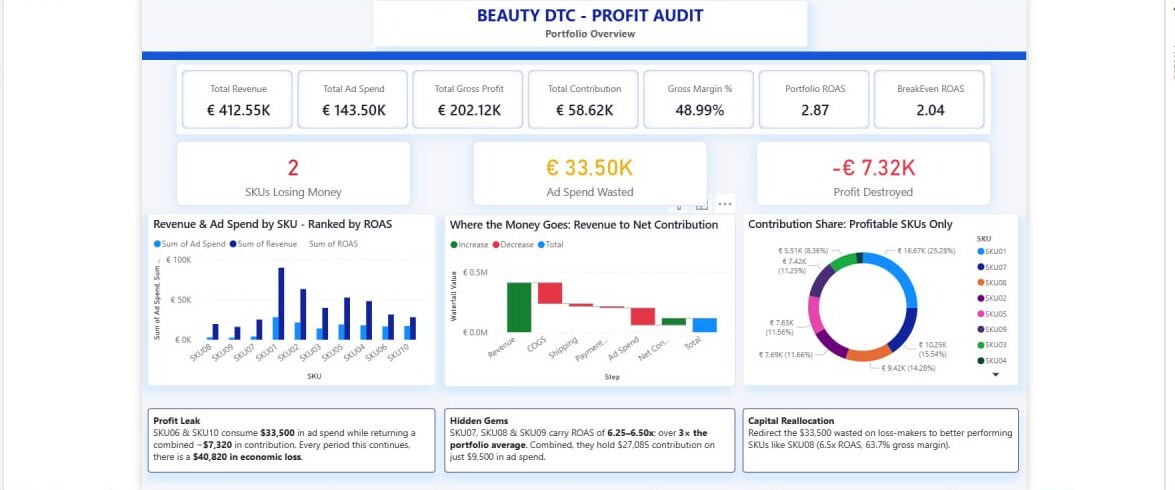
Beauty DTC profit audit dashboard, portfolio overview page

DTC e-commerce

Beauty DTC Profit Audit

Eight-page audit on a simulated beauty brand with €412.55K annual revenue across 10 SKUs. Surfaced €40,820 in misallocated capital, flagged two structurally loss-making SKUs, and built a live scenario simulator that models a +44% contribution uplift without launching a new product.

  • Disconnected dimension tables for shared-measure routing
  • VAR-driven contribution margin to avoid circular dependency
  • Three live what-if parameters driving simulated contribution
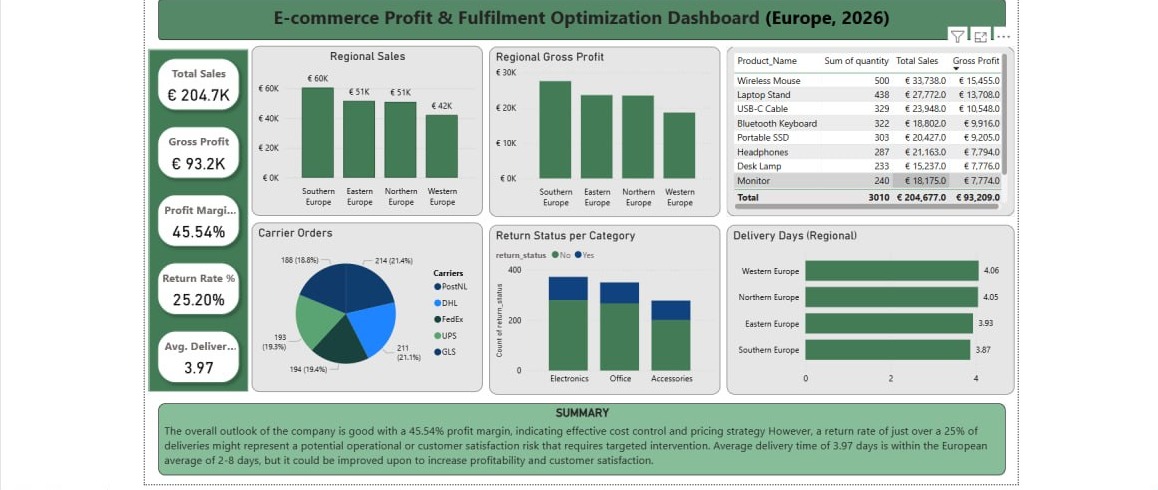
Logistics and fulfilment optimisation dashboard, executive summary page

Logistics and 3PL

Logistics and Fulfilment Optimisation

Six-page audit on a simulated pan-European fulfilment network. €204.7K in sales across 1,000 orders, 20 countries, and 5 carriers. Surfaced GLS at 31.91% return rate versus PostNL at 21.96% despite comparable delivery speed, and produced a country-level carrier reallocation plan.

  • Multi-carrier benchmarking across region and SKU
  • Return-rate anomaly detection separated from speed metrics
  • Five operating KPIs surfaced on a single executive page

How it works

Four steps from messy CSVs to a decision-ready audit

  1. 01

    Free 15-minute diagnostic call

    Bring one report you currently use to make a decision. I will tell you what is missing from it and what an audit would surface. No slide deck, no commitment.

  2. 02

    You send the data

    Order data, product cost data, carrier or shipping data, and any spend data you track. CSV or Excel. Messy is expected. Cleaning is part of the work.

  3. 03

    I build the audit

    Five to ten working days. The result is a six-page Power BI report with a scenario simulator, drill-through architecture, and a written diagnosis page. Same depth as the case studies above.

  4. 04

    You keep the file

    Delivered as a .pbix file. You can open it in the free Power BI Desktop on Windows. You only need a paid licence if you want to share it online with your team.

Pricing

Fixed-fee. Listed publicly. No retainers required upfront.

The audit is the wedge. Retainers are optional, and you only consider them after you have seen the work.

Where most engagements begin

Profit Audit

1,500

One-time, fixed fee

  • Six-page Power BI report on your data
  • SKU and segment-level profitability framework
  • Scenario simulator with live what-if parameters
  • Drill-through architecture down to row level
  • Four written recommendations tied to specific measures
  • Delivered as a .pbix file you keep, no licence needed to read
Book a discovery call

Insight Retainer

400/mo

Tier 1, after audit

  • Monthly data refresh
  • Scenario re-run on updated numbers
  • One dashboard adjustment per month
  • Written PDF brief on what changed
Ask about this tier

Embedded Analyst

900/mo

Tier 2, after audit

  • Weekly data refresh
  • Thirty-minute monthly review call
  • Unlimited dashboard adjustments
  • Faster turnaround on ad-hoc questions
Ask about this tier

Need more depth, faster turnaround, or live dashboards inside your environment? Ask about Tier 3.

About

Operator background. Clinical-diagnostic mindset. Advanced Power BI.

Kenechukwu (Donald) Ifeanyi-Ezeaka
Kenechukwu (Donald) Ifeanyi-Ezeaka, founder. Bratislava.

I am Kenechukwu (Donald) Ifeanyi-Ezeaka. K.I.E Advisory is the consultancy I run from Bratislava. The reason this audit works is not Power BI. The reason it works is that I spent three years inside European logistics operations at DB Schenker, Denso, PostNL, and Royal Flora Holland before I learned to build the dashboards. I have seen the difference between the spreadsheet the founder is looking at and the operational reality behind it. The audit is built to close that gap.

The Power BI work is self-taught and goes deeper than most agency output. The .pbix files I deliver use disconnected dimension tables for shared-measure routing, layered measure architecture from unit-level to portfolio-level via SUMX, VAR-driven contribution margin to avoid circular dependency, live what-if parameters for scenario simulation, drill-through pages, and tooltip canvas pages registered as tooltips. If those words mean something to you, you know the level. If they do not, the case studies show exactly what comes out the other side.

The diagnostic mindset comes from medical training. Symptoms are not the disease. A 7% drop in margin is a symptom. The disease is one specific carrier, or one specific channel, or one specific SKU mix decision that was made six months ago and never reviewed. The audit finds the disease.

FAQ

The questions every prospect asks

Do I need a Power BI licence to use the audit?

No. The audit is delivered as a .pbix file. You can open it in the free Power BI Desktop application on any Windows machine. A paid licence is only required if you want to publish the dashboard online for team access.

How long does an audit take?

Five to ten working days from the moment your data lands in my inbox. Most of that time is data cleaning and modelling, not analysis.

What data do you need?

CSV or Excel exports from your existing systems. Typical inputs are order data, product cost data, carrier or shipping data, and any spend data you already track. Messy is fine. Cleaning is part of the work.

Can you do it for less than €1,500?

Not at the same scope. I do offer an audit-lite at €750 with one KPI page, two or three findings, and no scenario simulator. Different product, different depth. Most clients find the full audit pays for itself on the first finding.

Who is this for?

DTC e-commerce brands doing roughly €500K to €10M in annual revenue who suspect their margin is leaking but cannot see where. Logistics operators and 3PLs running multiple carriers with patchy visibility into where the cost is going. Founders and operators who make decisions on Excel exports and want one source of truth.

Are the case study numbers from real clients?

No. Both case studies are built on simulated data that replicates real Shopify-tier unit economics and multi-carrier logistics flows. They are methodology demonstrations. The depth of the modelling, the DAX architecture, and the structure of the audit are identical to client work. Real client numbers stay with the client.

Book a free 15-minute diagnostic call.

Bring one report you currently use to make a decision. I will tell you what is missing from it and what an audit would surface. No commitment, no slide deck, no follow-up sequence.

Prefer LinkedIn? DM me there.